Wednesday, February 12, 2020

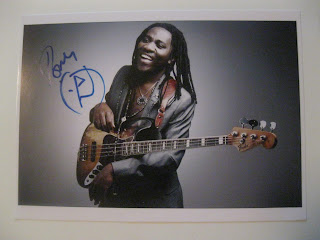
Richard Bona, jazz bassist and musician. He currently holds a professorship of music at New York University

Richard Bona (born October 28, 1967 in Minta, Cameroon) is a jazz bassist and musician. His actual African name, as he said live in Montreal in a show with Bobby McFerrin, is Bona Pinder Yayumayalolo.

Bona was born into a family of musicians, which enabled him to start learning music from a young age. His grandfather was a griot-- a West African singer of praise and storyteller-- and percussionist, and his mother was a singer. At 4 years old, Bona started to play the balafon. At the age of 5, he began performing at his village church. Not being wealthy, Bona made many of his own instruments: including flutes and guitars (with cords strung over an old motorcycle tank).
His talent was quickly noticed, and he was often invited to perform at festivals and ceremonies. Bona began learning to play the guitar at age 11, and in 1980 aged just 13, he assembled his first ensemble for a French jazz club in Douala. The owner befriended him and helped him discover jazz music, in particular that of Jaco Pastorius, which inspired Bona to switch his focus to the electric bass.

 Bona emigrated to Germany at the age of 22 to study music in Düsseldorf, soon relocating to France, where he furthered his studies in music.
Whilst in France, he regularly played in various jazz clubs, sometimes with players such as Manu Dibango, Salif Keita, Jacques Higelin and Didier Lockwood.
In 1995, Richard left France and established himself in New York, where he still lives and works. In New York he played bass guitar with artists like Joe Zawinul, Larry Coryell, Michael and Randy Brecker, Mike Stern, George Benson, Branford Marsalis, Chaka Khan, Bobby McFerrin, and Steve Gadd.
In 1998, Richard was the Musical Director on Harry Belafonte's European Tour.
His first solo album, Scenes from My Life, was released in 1999. He has also been prominently featured in Jaco Pastorius Big Band albums, as well as many other albums by various top-tier jazz musicians.
In 2002 Bona went on a world tour with the Pat Metheny Group as a percussionist/vocalist.
In 2005 Bona released his fourth album Tiki, which included a collaboration with John Legend on one track, entitled "Please Don't Stop."
He currently holds a professorship of music at New York University.
Discography

Richard Bona, 3 August 2006

Friday, February 7, 2020

Fritz d'Orey, a former racing driver, from Brazil. He participated in three Formula One World Championship Grands Prix

Frederico José Carlos Themudo "Fritz" d'Orey (born March 25, 1938 in São Paulo) is a former racing driver, from Brazil. He participated in three Formula One World Championship Grands Prix, debuting on July 5, 1959.
Although he was Brazilian by birth, Fritz d’Orey’s parents were Portuguese nationals and his grandfather a German. The family settled in São Paulo where they earned a more than comfortable living by importing Packard cars from America. Fritz wanted for nothing, and what he wanted was to go racing.

That was with a Porsche initially before the 20 year old bought Chico Landi’s Ferrari 375 that was now fitted with a V8 Corvette engine. Victory in the Interlagos endurance race of 1958 and further national success persuaded d’Orey to race in Europe.

Formula 1 career with Centro Sud and Tec-Mec

He joined Scuderia Centro Sud for the following season and his Maserati 250F was 10th at the 1959 French Grand Prix. The youngster was wild and ragged and a heavy crash during the subsequent British GP ended his immediate plans.

D’Orey also competed in hillclimbs, sports car races and Formula Junior events during 1959. He won an FJ race at Messina and was second in the United States GP support race at Sebring. D’Orey also made his third and final GP start that day with Camoradi USA’s Tec-Mec F415 – a strangely modified Maserati 250F
whose reshaped body certainly made the car no quicker. D’Orey retired early on in what was Tec-Mec’s only Formula 1 appearance.

Instead of open-wheel racing, the Brazilian planned a season in sports cars in 1960. He finished sixth in the Sebring 12 Hours with William Sturgis’s Ferrari 250GT but then crashed while testing before the Le Mans 24 Hours. D’Orey suffered severe head injuries in the accident and was hospitalised for eight months. Although he recovered fully, he was finished with racing. Instead he returned to work for his father’s business and eventually settled in Rio de Janeiro.


Friday, January 31, 2020

Ray Manzarek, an American musician, singer, producer, film director, and author, best known as a member of The Doors from 1965 to 1973, which he co-founded with singer and lyricist Jim Morrison

Raymond Daniel Manzarek Jr. (né Manczarek; February 12, 1939 – May 20, 2013) was an American musician, singer, producer, film director, and author, best known as a member of The Doors from 1965 to 1973, which he co-founded with singer and lyricist Jim Morrison. Manzarek was notable for performing on a keyboard bass during many live shows and some recordings, taking on a role usually filled by a bass guitar player.
Manzarek recorded on every track of all eight Doors studio albums, and was inducted into the Rock and Roll Hall of Fame in 1993. He was a co-founding member of Nite City from 1977 to 1978, and of Manzarek–Krieger from 2001 until his death in 2013. USA Today defined him as "one of the best keyboardists ever."

Following his return to the United States, he re-enrolled in UCLA's graduate film program in 1962, where he received a M.F.A. in cinematography in 1965.[7][8] During this period, he met future wife Dorothy Fujikawa and undergraduate film student Jim Morrison. At the time, Manzarek was in a band called Rick & the Ravens with his brothers Rick and Jim.[9] Forty days after finishing film school, thinking they had gone their separate ways, Manzarek and Morrison met by chance on Venice Beach in California. Morrison said he had written some songs, and Manzarek expressed an interest in hearing them, whereupon Morrison sang rough versions of "Moonlight Drive", "My Eyes Have Seen You" and "Summer's Almost Gone". Manzarek liked the songs and co-founded The Doors with Morrison at that moment.
During this period, Manzarek met guitarist Robby Krieger and drummer John Densmore at a Transcendental Meditation lecture and recruited them for the incipient band. Densmore said, "There wouldn't be any Doors without Maharishi."[10]
In January 1966, The Doors became the house band at the London Fog on the Sunset Strip. According to Manzarek, "Nobody ever came in the place...an occasional sailor or two on leave, a few drunks. All in all it was a very depressing experience, but it gave us time to really get the music together." The same day The Doors were fired from the London Fog, they were hired to be the house band of the Whisky a Go Go.[11]
The Doors' first recording contract was with Columbia Records. After a few months of inactivity, they learned they were on Columbia's drop list. At that point, they asked to be released from their contract. Following a few months of live gigs, Jac Holzman "rediscovered" The Doors and signed them to Elektra Records.
The Doors lacked a bass guitarist (except during recording sessions), so at live performances Manzarek played the bass parts on a Fender Rhodes Piano Bass. His signature sound was that of the Vox Continental combo organ, an instrument used by many other psychedelic rock bands of the era. He later used a Gibson G-101 Kalamazoo combo organ (which looks like a Farfisa) because the Continental's plastic keys frequently broke.
During the Morrison era, Manzarek was the group's regular backing vocalist. He occasionally sang lead, as exemplified by covers of Muddy Waters's "Close To You" (released on 1970s Absolutely Live) and "You Need Meat (Don't Go No Further)" (recorded during the L.A. Woman sessions and initially released as the B-side of "Love Her Madly"). He went on to share lead vocals with Krieger on the albums (Other Voices and Full Circle) released after Morrison's death.

Thursday, January 30, 2020

Richard J. Roberts, an English biochemist and molecular biologist. He was awarded the 1993 Nobel Prize in Physiology or Medicine with Phillip Allen Sharp for the discovery of introns in eukaryotic DNA and the mechanism of gene-splicing

Sir Richard John Roberts (born 6 September 1943) FRS[5] is English biochemist and molecular biologist. He was awarded the 1993 Nobel Prize in Physiology or Medicine with Phillip Allen Sharp for the discovery of introns in eukaryotic DNA and the mechanism of gene-splicing. He currently works at New England Biolabs.

In 1992, Roberts received an honorary doctorate from the Faculty of Medicine at Uppsala University, Sweden.[15] After becoming a Nobel Laureate in 1993 he was awarded an Honorary Degree (Doctor of Science) by the University of Bath in 1994.[16]
Roberts was elected a Fellow of the Royal Society (FRS) in 1995[5] and a member of the European Molecular Biology Organization (EMBO) in the same year.[6] In 2005, a multimillion-pound expansion to the chemistry department at the University of Sheffield, where he had been a student, was named after him. A refurbished science department at Beechen Cliff School (previously City of Bath Boys' School) was also named after Roberts, who had donated a substantial sum of his Nobel prize winnings to the school.[17]
Roberts is an atheist and was one of the signers of the Humanist Manifesto.[18][19] He was knighted in the 2008 Birthday Honours.
Roberts is a member of the Advisory Board of Patient Innovation (https://patient-innovation.com), a nonprofit, international, multilingual, free venue for patients and caregivers of any disease to share their innovations.
Roberts has been a keynote speaker at the Congress of Future Medical Leaders (2014, 2015, 2016).[citation needed]
He also is the chairman of The Laureate Science Alliance, a non-profit supporting research worldwide.

Monday, January 27, 2020

Klaus Iohannis, the president of Romania

Klaus Werner Iohannis (also spelled Johannis; born 13 June 1959) is president of Romania. He became leader of the National Liberal Party (PNL) in 2014, after having served as leader of the Democratic Forum of Germans in Romania (DFDR/FDGR) from 2001 to 2013. Iohannis was a physics teacher and a school inspector before entering full-time politics.
Iohannis was elected the mayor of the city of Sibiu in 2000, representing the Democratic Forum of Germans in Romania. Although the German population of the once predominantly German-speaking city of Sibiu (German: Hermannstadt, Transylvanian Saxon dialect: Härmeschtat) had declined to a tiny minority, Iohannis won a surprise victory and was re-elected by landslides in 2004, 2008, and 2012. Iohannis is credited with turning his city into one of Romania's most popular tourist destinations, and the city was declared the European Capital of Culture in 2007. In February 2013, Iohannis became a member of the National Liberal Party, accepting an invitation from then liberal leader Crin Antonescu, and was immediately elected the party's First Vice President, eventually becoming the PNL President during the following year.
In October 2009, four of the five political groups in the Parliament, excluding the Democratic Liberal Party of then-President Traian Băsescu, proposed him as a candidate for the office of Prime Minister of Romania; however, Băsescu refused to nominate him despite the Parliament's adoption of a declaration supporting his candidacy.[3] He was again the candidate for Prime Minister of the National Liberal Party and the Social Democratic Party in the elections in the same year.[4]
Iohannis is the first Romanian president to come from an ethnic minority.[5] He is a Transylvanian Saxon, part of Romania's German minority which settled in Transylvania in the 12th century. He was re-elected in the 2019 Romanian presidential election.

Wednesday, January 22, 2020

Helmuth Duckadam, retired footballer who played as a goalkeeper. He was dubbed "the Hero of Seville" due to his display in the 1986 European Cup Final, won by his main club Steaua Bucureşti, where he saved all four penalties against Barcelona in the penalty shootout, for the first time in football history

Helmuth Robert Duckadam (born 1 April 1959) is a Romanian retired footballer who played as a goalkeeper and the current president of FC FCSB.
He was dubbed "the Hero of Seville" due to his display in the 1986 European Cup Final, won by his main club Steaua Bucureşti, where he saved all four penalties against Barcelona in the penalty shootout, for the first time in football history. He represented three other teams in a 14-year senior career.
Duckadam regularly appears as a studio guest on Digi Sport's "Fotbal Club" programme.

Born in Semlac, Arad County of Banat Swabian descent, Duckadam started playing in his regional leagues, before moving to FC UTA Arad in 1978 to become professional. He earned two full caps for Romania in 1982 and, subsequently, was signed by country giants FC Steaua Bucureşti.
capital side to two consecutive Liga I titles, was also between the posts for the 1986 European Cup final against FC Barcelona, which was played in Seville, on 7 May 1986. He saved four consecutive penalty shots in the shootout, from José Ramón Alexanko, Ángel Pedraza, Pichi Alonso and Marcos, being the first one to do so in an official European competition. Steaua won the shootout 2–0 and Europe's most important club trophy for the first time, and much of the credit for the surprise victory was given to him; he scored one goal for his main club, through a penalty kick against AFC Progresul Bucureşti in the domestic cup.[1]


In 1986, Duckadam suffered a rare blood disorder only few weeks after the Seville performance,[2] and would only resume his career three years later, finishing it with lowly Vagonul Arad in the second division. According to a personal interview given in 1999, he had become a major with the Romanian Border Police (Poliția de Frontieră) in his hometown; additionally, he opened a football school in the city, named after himself.[3]
 
On 25 March 2008, Duckadam was decorated by the President of Romania, Traian Băsescu, with Ordinul "Meritul Sportiv" – ("The Sportive Merit" Order – class II), for his part in winning the 1986 European Cup. Two years later, on 11 August, he was named Steaua's president.


Saturday, January 18, 2020

Mario Andretti, an Italian-born American former racing driver, one of the most successful Americans in the history of the sport

Mario Gabriele Andretti (born February 28, 1940) is an Italian-born American former racing driver, one of the most successful Americans in the history of the sport.[1] He is one of only two drivers to have won races in Formula One, IndyCar, World Sportscar Championship, and NASCAR (the other being Dan Gurney). He also won races in midget cars and sprint cars.

During his career, Andretti won the 1978 Formula One World Championship, four IndyCar titles (three under USAC-sanctioning, one under CART), and IROC VI. To date, he remains the only driver ever to win the Indianapolis 500 (1969), Daytona 500 (1967) and the Formula One World Championship, and, along with Juan Pablo Montoya, the only driver to have won a race in the NASCAR Cup Series, Formula One, and an Indianapolis 500. No American has won a Formula One race since Andretti's victory at the 1978 Dutch Grand Prix.[2] Andretti had 109 career wins on major circuits.[3]
Andretti had a long career in racing. He was the only person to be named United States Driver of the Year in three decades (1967, 1978, and 1984).[4] He was also one of only three drivers to have won major races on road courses, paved ovals, and dirt tracks in one season, a feat that he accomplished four times.[4] With his final IndyCar win in April 1993, Andretti became the first driver to have won IndyCar races in four different decades[5] and the first to win automobile races of any kind in five.[4]
In American popular culture, his name has become synonymous with speed, as with Barney Oldfield in the early twentieth century and Stirling Moss in the United Kingdom.
In 1986, he was inducted into the Indianapolis Motor Speedway Hall of Fame. In 2000, the Associated Press and RACER magazine named him Driver of the Century.[53] He was the Driver of the Year (in the United States) for three years (1967, 1978, and 1984),[54] and is the only driver to be Driver of the Year in three decades.[16] Andretti was named the U.S. Driver of the Quarter Century in 1992.[3] He was inducted into the International Motorsports Hall of Fame in 2001,[3] the United States National Sprint Car Hall of Fame in 1996,[7] the Motorsports Hall of Fame of America[55] in 1990, the Hoosier Auto Racing Hall of Fame in 1970,[7] the Automotive Hall of Fame in 2005 and the Diecast Hall of Fame in 2012.
On October 23, 2006, Andretti was awarded the highest civilian honor given by the Italian government, the Commendatore dell'Ordine al Merito della Repubblica Italiana (known as the Commendatore), in honor of his racing career, public service, and enduring commitment to his Italian heritage.[53] Enzo Ferrari is the only other recipient of the Commendatore from the world of automobile racing.
In 2007, Andretti was honored with the "Lombardi Award of Excellence" from the Vince Lombardi Cancer Foundation. The award was created to honor Coach Lombardi's legacy, and is awarded annually to an individual who exemplifies the spirit of the Coach.
From 2007 Mario Andretti is the "Mayor" (Sindaco) of the "Free Commune of Motovun in Exile" (Libero Comune di Montona in esilio), an association of Italian exiles from Motovun.